

Quick Answer
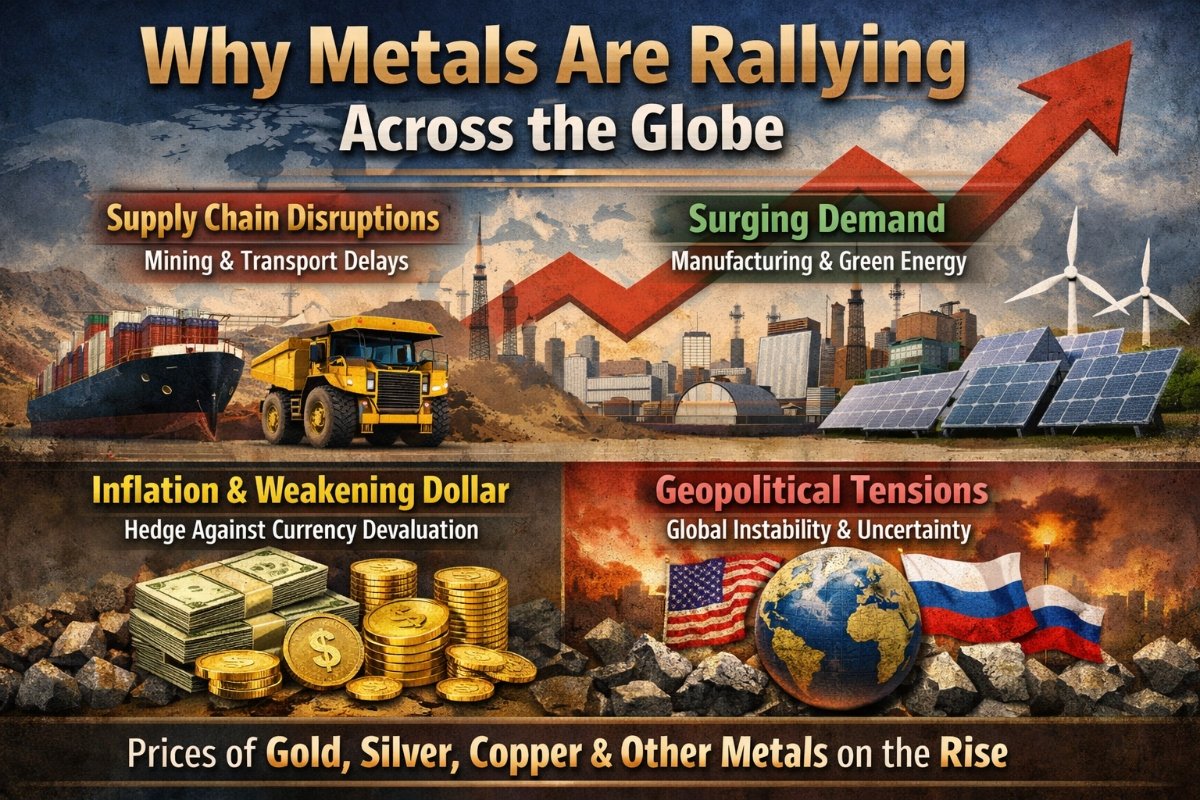
Metals are rallying across the globe in 2026 due to a convergence of factors: persistent inflation concerns driving safe-haven demand, aggressive central bank gold buying, supply chain constraints, surging renewable energy and EV manufacturing requirements, and escalating geopolitical tensions that have investors seeking tangible assets over traditional equities.
Key Drivers at a Glance:
- Silver industrial demand reached all-time highs from solar panel production
- Central banks purchased record gold volumes in 2025, continuing into 2026
- Copper demand surged 18% year-over-year due to electrification trends
- Inflation remains above 3% in major economies, boosting precious metals appeal
- Geopolitical instability in mining regions disrupted base metal supplies
Understanding the 2026 Metals Rally
The global metals market is experiencing one of its most dramatic rallies in recent history. From precious metals like gold and silver to industrial powerhouses like copper and aluminum, prices have surged across the board. This isn’t a speculative bubble—it’s a fundamental shift driven by structural economic changes, technological transitions, and evolving investment strategies.
Unlike previous commodity cycles, the metals rally 2026 reflects both traditional safe-haven demand and unprecedented industrial consumption. Investors who dismissed commodities as “old economy” assets are now scrambling to understand why metals have outperformed equities in the first quarter.
The Economic Backdrop: Inflation and Monetary Policy
Persistent Inflation Concerns
Despite central banks’ efforts throughout 2024 and 2025, inflation has proven stubbornly resilient. Major economies continue to register inflation rates between 3-4%, well above target levels. This environment has made precious metals investment increasingly attractive as an inflation hedge.
Gold, traditionally viewed as a store of value during inflationary periods, has benefited tremendously. The gold price 2026 trajectory shows a 22% gain year-to-date, with prices testing historic resistance levels near $2,950 per ounce.
Central Bank Gold Accumulation
Central banks, particularly in emerging markets, have dramatically accelerated gold reserve accumulation. The Reserve Bank of India (RBI) added 45 tonnes to its reserves in the first quarter of 2026 alone. China’s People’s Bank continued its 18-month buying streak, while central banks collectively purchased over 1,200 tonnes in 2025—the highest annual total since 1967.
This institutional demand creates a powerful floor under gold prices, as central bank purchases rarely reverse quickly. When the world’s monetary authorities view gold as essential, private investors take notice.
Industrial Metals: The Electrification Supercycle
Copper—The Metal of Electrification
The copper price forecast for 2026 has consistently surprised analysts to the upside. Copper surged past $11,000 per tonne, driven by insatiable demand from renewable energy infrastructure, electric vehicle manufacturing, and grid modernization projects.
Electric vehicles require approximately 83 kilograms of copper per vehicle—four times more than internal combustion vehicles. With global EV sales projected to exceed 25 million units in 2026, the arithmetic is straightforward: demand is outpacing mine supply.
Major copper-producing regions in Chile and Peru have faced production challenges, from water scarcity to social unrest. These supply chain disruptions have tightened an already deficit market, creating the perfect conditions for the base metals outlook to remain bullish.
Silver’s Industrial Renaissance
The silver price surge has been equally impressive, with prices climbing above $35 per ounce. While silver maintains its precious metal status, its industrial applications now drive over 60% of demand.
Solar panel manufacturing consumes approximately 140 million ounces of silver annually, and this figure is growing as countries accelerate renewable energy targets. India’s ambitious 500 GW renewable capacity goal by 2030 alone requires substantial silver imports.
Silver’s dual nature—both industrial metal and monetary asset—makes it particularly compelling. When inflation concerns and industrial demand align, silver often outperforms gold in percentage terms.
Geopolitical Tensions and Safe-Haven Demand
Understanding Safe-Haven Assets
A safe-haven asset is an investment expected to retain or increase value during periods of market turbulence, economic uncertainty, or geopolitical instability. Precious metals have served this function for millennia.
In 2026, escalating tensions across multiple regions have driven unprecedented flows into safe-haven assets. Trade disputes, military conflicts, and diplomatic standoffs have created an environment where investors prioritize capital preservation over growth.
The Flight to Tangible Assets
Unlike equities or bonds, physical metals cannot default, be hacked, or lose value through counterparty risk. This tangibility becomes especially valuable when confidence in financial institutions or government currencies wavers.
The metals vs equities comparison in 2026 reveals a striking divergence. While major stock indices have experienced significant volatility, gold mining stocks and metal-backed ETFs have delivered consistent positive returns.
Supply Chain Dynamics and Production Challenges
Mining Sector Constraints
Despite surging prices, mining companies cannot quickly increase production. Developing new mines requires 7-10 years from discovery to production. This lag means today’s price signals won’t translate into new supply until the early 2030s.
Existing mines face rising operational costs, stricter environmental regulations, and aging ore deposits. The average grade of copper ore mined globally has declined by 30% over the past decade, requiring more processing for less output.
Strategic Resource Nationalism
Governments in resource-rich nations increasingly view metals as strategic assets. Export restrictions, higher royalties, and demands for domestic processing are constraining global supply. This trend accelerated in 2025 and shows no signs of reversing.
Indonesia’s nickel export ban, implemented to develop domestic battery manufacturing, exemplifies this approach. Similar policies are under consideration in Chile, Peru, and the Democratic Republic of Congo—countries that collectively control over 60% of critical metal production.
India’s Role in the Global Metals Rally
MCX Trends and Domestic Demand
India’s Multi Commodity Exchange (MCX) has witnessed record trading volumes in precious metals contracts. Gold futures on MCX surged past ₹73,000 per 10 grams, while silver crossed ₹86,000 per kilogram.
Domestic demand remains robust despite high prices. Indian household gold demand, culturally significant and traditionally strong, adapted through smaller purchase sizes rather than complete withdrawal from the market.
Indian Investment Flows
Indian investors have dramatically increased their exposure to metal-backed securities. Gold ETF inflows in India crossed ₹8,500 crore in the first quarter of 2026, representing a 140% increase year-over-year.
This shift reflects growing financial literacy and awareness of portfolio diversification benefits. Younger investors, particularly in urban centers, view gold ETFs as a modern alternative to physical gold, offering liquidity and lower storage costs.
Understanding the Commodity Supercycle
Defining a Commodity Supercycle
A commodity supercycle is an extended period—typically 10-20 years—of above-trend commodity prices driven by fundamental structural shifts in supply and demand, rather than short-term economic fluctuations.
Many analysts believe we entered a new commodity supercycle in 2024, driven by the global energy transition, infrastructure investment in emerging markets, and deglobalization trends that emphasize supply security over efficiency.
This Time Is Different?
While “this time is different” are often the four most dangerous words in investing, the current rally has unique characteristics. The convergence of decarbonization goals, technological transformation, and monetary instability creates a multi-decade tailwind that wasn’t present in previous cycles.
The last major commodity supercycle (2000-2014) was primarily driven by Chinese industrialization. The current cycle reflects broader global trends affecting both developing and developed economies simultaneously.
What Should Investors Do Now?
Evaluating Investment Vehicles
Investors have multiple options for gaining metals exposure, each with distinct characteristics:
Physical Metals: Offers direct ownership and maximum security, but involves storage costs and liquidity challenges. Best suited for long-term holders seeking wealth preservation.
ETFs vs Physical Metals: Gold and silver ETFs provide liquidity and ease of trading without storage concerns. However, they represent claims on metal rather than direct ownership. Popular options include Gold BeES in India and GLD in the United States.
Mining Stocks: Offer leveraged exposure to metal prices but carry operational risks and management quality concerns. Diversified mining ETFs reduce company-specific risk.
Futures and Options: Suitable only for sophisticated investors given leverage and complexity. MCX provides accessible futures contracts for Indian investors.
Diversification Strategies
A balanced approach might allocate 5-15% of a portfolio to metals, split between precious metals (gold, silver) and base metals exposure (copper, aluminum). This provides both defensive characteristics and growth potential.
Geographic diversification also matters. Indian investors heavily weighted toward domestic gold might consider international mining stocks or base metals to achieve true diversification.
Understanding Inflation Hedge Mechanics
An inflation hedge is an investment expected to maintain or increase real value during periods of rising prices. Precious metals historically preserve purchasing power across decades, even if short-term volatility exists.
Base metals serve as inflation hedges through different mechanics—their prices rise with replacement costs and industrial demand that typically correlates with nominal economic growth.
Diversification Strategies
A balanced approach might allocate 5-15% of a portfolio to metals, split between precious metals (gold, silver) and base metals exposure (copper, aluminum). This provides both defensive characteristics and growth potential.
Geographic diversification also matters. Indian investors heavily weighted toward domestic gold might consider international mining stocks or base metals to achieve true diversification.
Understanding Inflation Hedge Mechanics
An inflation hedge is an investment expected to maintain or increase real value during periods of rising prices. Precious metals historically preserve purchasing power across decades, even if short-term volatility exists.
Base metals serve as inflation hedges through different mechanics—their prices rise with replacement costs and industrial demand that typically correlates with nominal economic growth.
Risk Factors and Potential Corrections
No Investment Is Risk-Free
Despite strong fundamentals, metals markets can experience sharp corrections. Potential risks include:
Aggressive Monetary Tightening: If central banks successfully crush inflation through higher interest rates, opportunity costs of holding non-yielding metals increase.
Technological Substitution: Breakthrough technologies could reduce metal intensity in manufacturing, though this typically unfolds over decades.
Demand Destruction: Severe global recession could temporarily reduce industrial metals demand, though precious metals often benefit from such scenarios.
Speculative Excesses: When retail investors pile into assets solely because prices are rising, corrections often follow.
Watching Key Indicators
Informed investors monitor several metrics: central bank policy statements, manufacturing PMI data, inventory levels at major exchanges (COMEX, LME, MCX), and mining company production reports.
The gold-to-silver ratio, currently around 84:1, historically reverts to mean levels near 70:1, suggesting potential silver outperformance if the ratio compresses.
Precious Metals vs Base Metals: Different Drivers
Precious Metals—Monetary and Safe-Haven Focus
Gold and silver primarily respond to monetary conditions, geopolitical stress, and currency fluctuations. They tend to strengthen when real interest rates (nominal rates minus inflation) are low or negative.
Investment demand dominates precious metals pricing. Jewelry and industrial uses provide a baseline, but investor positioning determines marginal price movements.
Base Metals—Industrial Demand Foundation
Copper, aluminum, nickel, and zinc prices reflect industrial production, construction activity, and manufacturing trends. They’re economically sensitive and cyclical.
The current rally in base metals reflects genuine supply deficits and surging demand from electrification, distinguishing it from purely financial or speculative drivers.
Global Context: US and China Demand Patterns
United States—Infrastructure and Defense
American infrastructure investment, including the bipartisan infrastructure bill’s ongoing deployment, drives sustained base metals demand. Defense spending increases also boost specialty metals consumption.
US investor interest in precious metals ETFs reached five-year highs in early 2026, reflecting concerns about fiscal sustainability and currency debasement.
China—The Transition Challenge
China’s economy continues transitioning from construction-intensive growth toward consumption and technology. While traditional steel demand moderates, copper and specialized metals for electronics, batteries, and renewable energy are growing rapidly.
Chinese strategic stockpiling of critical metals adds another layer of demand that’s difficult to quantify but clearly impacts market balances.
Key Takeaways
- Multiple investment vehicles available: From physical metal to ETFs to mining stocks, investors can tailor exposure to their objectives
- Structural drivers support multi-year rally: The convergence of electrification, inflation concerns, and supply constraints creates durable support for metals prices
- Central bank buying provides price floor: Record official sector gold purchases signal institutional confidence in precious metals
- Industrial demand exceeds supply growth: Mining production cannot quickly respond to surging consumption from EVs and renewables
- Diversification benefits remain compelling: Metals offer portfolio protection during equity market volatility and inflation
- India plays dual role: Both as major consumer and increasingly sophisticated investor market
- Risk management essential: Despite strong fundamentals, tactical corrections can occur; position sizing matters
Stay Ahead of the Metals Market
The metals rally 2026 represents more than a short-term trading opportunity—it reflects fundamental shifts in the global economy that will unfold over years and decades. Whether you’re a conservative investor seeking portfolio protection or an aggressive trader capitalizing on momentum, understanding these dynamics is essential.
Monitor central bank policies, track industrial demand indicators, and maintain disciplined position sizing. The metals market rewards patient, informed investors who look beyond headlines to understand underlying supply-demand fundamentals.
Subscribe to commodity market updates, follow MCX trends, and stay informed about geopolitical developments affecting mining regions. In an era of economic uncertainty and technological transformation, metals offer both protection and opportunity—but only for those who do their homework.
Frequently Asked Questions
⚠️ Disclaimer: AI-generated content for educational purposes only. Not financial advice. Verify all information independently. Consult professionals before investing. Investments carry risk.