
Table of Contents
Introduction
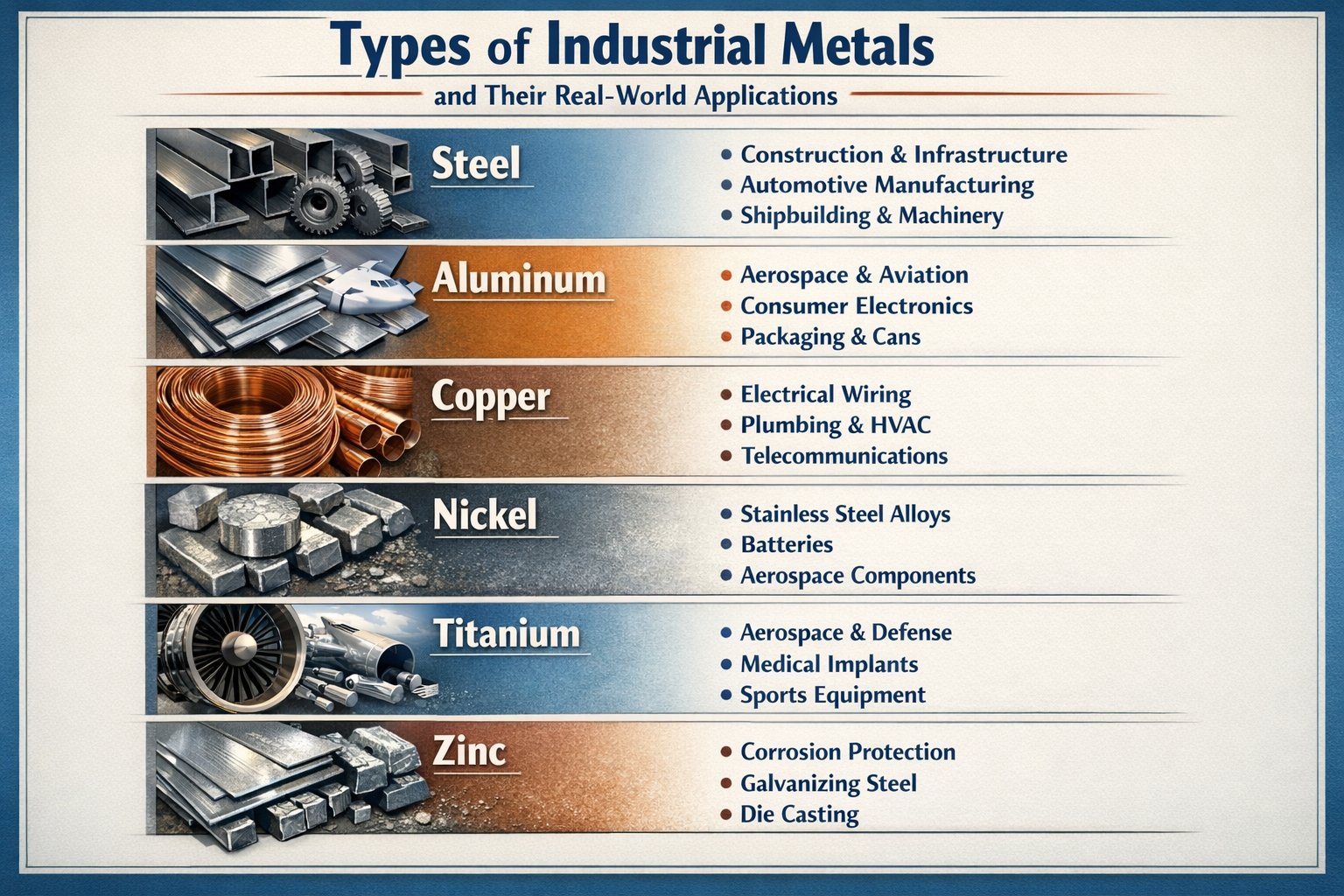
Industrial metals form the backbone of modern civilization. From the steel beams that support skyscrapers to the copper wires that conduct electricity across cities, metals are embedded in virtually every sector of industry — construction, automotive, aerospace, electronics, energy, and manufacturing. Their unique physical and chemical properties make them indispensable where strength, durability, conductivity, or corrosion resistance is required.
Selecting the right metal for a given application is not a trivial decision. It involves balancing mechanical properties, environmental conditions, cost constraints, weight requirements, and long-term maintenance considerations. A poor choice can result in structural failure, premature corrosion, cost overruns, or safety hazards. A well-informed choice, on the other hand, maximizes performance and service life while minimizing total cost of ownership.
This guide provides a thorough examination of the most widely used industrial metals — both ferrous and non-ferrous — covering their defining properties, typical applications, advantages, and limitations. Whether you are specifying materials for a construction project, designing a mechanical component, or simply seeking to understand the key differences between major metal types, this article offers a structured and practical reference.
What Are Industrial Metals?
Industrial metals are metallic materials extracted, refined, and processed for use in manufacturing, construction, and engineering applications. Unlike precious metals such as gold or platinum — valued primarily for rarity and aesthetic properties — industrial metals are selected for functional attributes: mechanical strength, thermal conductivity, electrical conductivity, machinability, weldability, and resistance to corrosion or heat.
Industrial metals are broadly classified into two major categories based on their iron content:
Ferrous Metals
Metals that contain iron as their primary constituent. Characterized by high tensile strength and magnetic properties, but generally susceptible to rust without protective treatment. Examples: carbon steel, alloy steel, cast iron.
Non-Ferrous Metals
Metals that do not contain iron. Typically offer superior corrosion resistance, lighter weight, and better electrical conductivity. Often preferred in corrosive environments or where weight savings are critical. Examples: aluminum, copper, brass, zinc.
★ Industry Fact
Steel — the most widely used industrial metal — accounts for approximately 1.9 billion tonnes of annual global production. It is used in everything from automotive body panels and railway tracks to medical equipment and kitchen appliances, making it one of the most versatile engineered materials in existence.
Section 1
Ferrous Metals
Ferrous metals — those containing iron — represent the majority of all metal used globally in industrial and construction settings. Their defining characteristics include high tensile strength, magnetic properties, and relatively low cost, though they require protective coatings or alloying to resist oxidation. The three primary categories covered here are carbon steel, alloy steel, and cast iron.
1.1 Carbon Steel
Overview: Carbon steel is an alloy of iron and carbon, with carbon content typically ranging from 0.05% to 2.0%. It is the most commonly produced and used form of steel worldwide. Properties vary significantly based on carbon content, leading to the classification of low-carbon (mild), medium-carbon, and high-carbon steel.
Grades and Composition
| Grade | Carbon Content | Characteristics |
|---|---|---|
| Low-Carbon (Mild) | 0.05% – 0.25% | Soft, highly ductile, excellent weldability. Used in structural fabrication and sheet metal. |
| Medium-Carbon | 0.26% – 0.60% | Balanced strength and ductility. Suited to automotive components, railways, and machine parts. |
| High-Carbon | 0.61% – 2.0% | Very hard and strong but less ductile. Used for cutting tools, springs, and wire ropes. |
Key Properties
- Tensile strength: 400–900 MPa depending on carbon content and heat treatment
- High machinability and weldability (especially mild steel)
- Low cost relative to other metals — the most economical structural option
- Susceptible to corrosion — requires galvanizing, painting, or protective coating
- Magnetic properties make it suitable for electromagnetic applications
Primary Applications
- Structural steel frameworks in buildings, bridges, and warehouses
- Reinforcing bars (rebar) in reinforced concrete construction
- Automotive body panels, chassis frames, and exhaust systems
- Pipelines for oil, gas, and water transport
- Industrial machinery, cutting tools, and agricultural equipment
⚠ Limitation to Note
Carbon steel’s primary weakness is its vulnerability to rust and oxidation when exposed to moisture and oxygen. In marine or high-humidity environments, uncoated carbon steel degrades rapidly. For such applications, stainless steel or corrosion-resistant alloys are often preferred.
1.2 Alloy Steel
Overview: Alloy steel is produced by adding specific alloying elements — chromium, nickel, molybdenum, vanadium, manganese, or tungsten — to plain carbon steel. These additions alter the microstructure of the steel to enhance properties that plain carbon steel cannot achieve: greater hardness, toughness, wear resistance, and corrosion resistance.
Common Alloying Elements and Their Effects
| Element | Effect on Steel Properties |
|---|---|
| Chromium | Increases hardness, tensile strength, and corrosion resistance. At 10.5%+ forms stainless steel. |
| Nickel | Improves toughness and corrosion resistance, particularly at low temperatures. |
| Molybdenum | Enhances strength at elevated temperatures and improves resistance to pitting corrosion. |
| Vanadium | Refines grain structure, increasing toughness and fatigue resistance. |
| Manganese | Improves hardness, hardenability, and tensile strength while reducing brittleness. |
Key Properties
- Tensile strength can exceed 1,500 MPa in high-performance grades
- Superior hardness and wear resistance compared to plain carbon steel
- Improved toughness and fatigue resistance under cyclic loading
- Better high-temperature performance — suitable for boilers and pressure vessels
- Enhanced corrosion resistance, especially in chromium-containing alloys
Primary Applications
- Aerospace structures, turbine blades, and jet engine components
- Automotive transmission gears, axles, and high-performance drive shafts
- High-performance ball bearings and roller bearings
- Pressure vessels and boilers operating at elevated temperatures
- Military armor plating and ballistic-resistant structures
- Tool steels for drills, molds, and industrial cutting equipment
1.3 Cast Iron
Overview: Cast iron is a group of iron-carbon alloys with carbon content greater than 2%, making it distinctly different from steel. The high carbon content makes cast iron exceptionally hard but inherently brittle — it lacks the ductility of steel and cannot be easily rolled, forged, or welded. Instead, it is poured in molten form into molds, giving rise to its name.
Types of Cast Iron
- Grey Cast Iron: The most common type. Contains graphite in flake form, providing good machinability and excellent vibration-damping properties.
- White Cast Iron: Very hard and wear-resistant but extremely brittle. Used in mining equipment and abrasion-wear surfaces.
- Ductile (Nodular) Cast Iron: Contains spheroidal graphite nodules, offering improved ductility and impact resistance over grey cast iron.
- Malleable Cast Iron: Produced by heat-treating white cast iron; offers moderate ductility and is used in pipe fittings and automotive parts.
Primary Applications
- Engine blocks, cylinder heads, and brake discs in automotive manufacturing
- Water and sewer pipes in civil infrastructure
- Manhole covers and storm drain gratings
- Machine tool bases and lathe beds where vibration damping is important
- Cookware (cast iron pans and Dutch ovens) due to exceptional heat retention
Section 2
Non-Ferrous Metals
Non-ferrous metals do not contain iron as a primary constituent. As a result, they do not rust (though some corrode in other ways) and are generally non-magnetic. Their properties — low density, high conductivity, excellent corrosion resistance — make them essential in applications where ferrous metals would be unsuitable.
2.1 Aluminum
Overview: Aluminum is the most abundant metal in Earth’s crust and the second most widely used industrial metal after steel. Its remarkable combination of low density, high strength-to-weight ratio, excellent corrosion resistance, and good electrical conductivity make it one of the most versatile materials in modern engineering.
Key Properties
- Density: 2.7 g/cm³ — approximately one-third the density of steel
- Excellent natural corrosion resistance due to a self-forming aluminum oxide layer
- Good electrical conductivity — approximately 61% of copper at one-third the weight
- High thermal conductivity — effective for heat exchangers and cooling applications
- Highly recyclable — recycling requires only 5% of the energy needed for primary production
- Tensile strength: 70–700 MPa depending on alloy grade and temper
Primary Applications
- Aerospace: fuselages, wing skins, structural frames, and helicopter components
- Automotive: engine blocks, wheels, body panels, and structural components for weight reduction
- Building and construction: window frames, cladding, curtain walls, and roofing systems
- Packaging: beverage cans, food trays, and pharmaceutical foil
- Electrical transmission lines — preferred for high-voltage overhead lines due to lower weight
- Consumer electronics: laptop casings, smartphone frames, and heat sinks
💡 Why Aluminum Is Preferred in Automotive Manufacturing
Modern vehicles must balance structural safety with fuel efficiency. By substituting aluminum for steel in body panels, hoods, and structural members, manufacturers can reduce vehicle weight by 30–40% in those components, directly improving fuel economy and reducing CO₂ emissions. High-strength aluminum alloys (7000 series) approach the structural performance of mild steel at a fraction of the mass.
2.2 Copper
Overview: Copper is one of the oldest metals used by humans and remains critically important in modern industry. Its unmatched electrical conductivity — the highest of any non-precious metal — combined with excellent thermal conductivity, ductility, and natural corrosion resistance makes copper the preferred material for electrical infrastructure and plumbing systems worldwide.
Key Properties
- Electrical conductivity: 58.7 MS/m — the international benchmark (100% IACS)
- Excellent thermal conductivity: 401 W/m·K
- Outstanding corrosion resistance in most natural environments
- Highly ductile and malleable — can be drawn into extremely fine wire
- Antimicrobial properties — copper surfaces naturally kill bacteria and viruses
- Tensile strength: 200–250 MPa (pure copper); alloys reach significantly higher values
Primary Applications
- Electrical wiring, power cables, and motor windings (the largest single use of copper globally)
- Plumbing pipes and fittings in residential, commercial, and industrial buildings
- Heat exchangers, radiators, and air conditioning coils
- Printed circuit boards and electronic components
- Antimicrobial touch surfaces in hospitals and healthcare facilities
- Roofing, gutters, and architectural cladding (develops a distinctive green patina over time)
2.3 Brass
Overview: Brass is a copper-zinc alloy, typically containing between 60% and 90% copper with the balance being zinc. By varying the ratio of copper to zinc, a wide range of mechanical and physical properties can be achieved, making brass one of the most versatile alloy families in industrial use. It is distinguishable by its bright, yellow-gold appearance.
Key Properties
- Excellent machinability — free-cutting brass has the highest machinability of any copper alloy
- Good corrosion resistance in water, mild acids, and marine environments
- Low friction coefficient — resists galling and seizing under pressure
- Non-sparking properties make it safe around flammable gases or explosives
- Tensile strength: 300–580 MPa depending on alloy composition and temper
Primary Applications
- Plumbing fittings, valves, and connectors
- Electrical connectors, terminals, and switchgear components
- Musical instruments (trumpets, trombones, French horns) — valued for acoustic resonance properties
- Precision engineering: gears, bearings, bushings, and clock mechanisms
- Marine hardware: cleats, stanchions, and boat fittings
- Architectural hardware: door handles, hinges, knobs, and decorative nameplates
2.4 Zinc
Overview: Zinc is a bluish-white metal best known for its role as a protective coating for steel — a process called galvanizing. Approximately 60% of all zinc produced globally is used for galvanizing, underscoring its critical importance as a corrosion-prevention material. Beyond galvanizing, zinc is widely used in die-casting alloys and brass production.
Key Properties
- Excellent corrosion resistance — forms a stable zinc carbonate patina as a further protective barrier
- Galvanic (cathodic) protection: zinc acts as a sacrificial anode, protecting steel even when the coating is scratched
- Low melting point: 419.5°C — ideal for pressure die-casting of complex components
- Good dimensional stability and precision in die-cast form
- Tensile strength: 200–400 MPa in zinc alloys
Primary Applications
- Hot-dip galvanizing of steel structures, fasteners, and pipelines
- Die-cast components for automotive, hardware, and electronic housings
- Zinc alloy (Zamak) components: door knobs, lock bodies, and carburetor parts
- Roofing and cladding systems, particularly prevalent in European architecture
- Sacrificial anodes to protect ship hulls, offshore platforms, and underground pipelines
Section 3
Industrial Metals Comparison Table
The table below provides a side-by-side comparison across key selection criteria. Use this as a quick reference when evaluating material options for a project.
ⓘ Strength and cost ratings are relative comparisons within the context of common industrial metals. Actual values depend on specific alloy grade, heat treatment, form factor, and prevailing market conditions.
Section 4
How to Choose the Right Metal for Your Project
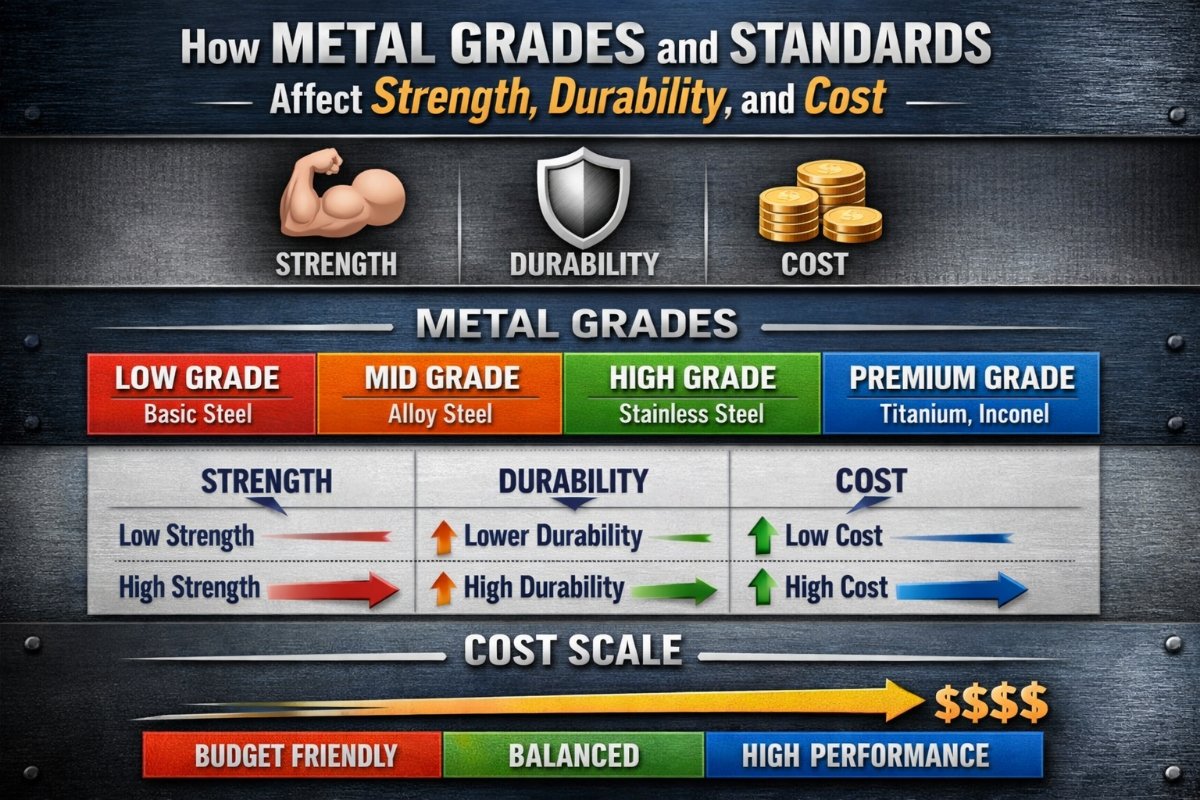
Selecting the optimal metal requires a systematic evaluation of multiple interdependent factors. No single metal is universally superior — the right choice is always context-dependent. The following six-factor framework provides a structured approach to material selection.
① Mechanical Load Requirements
Consider the type and magnitude of forces the metal must withstand. For high tensile loads — structural beams, columns under compression, or pressure vessel walls — high-strength steels are the typical starting point. For components subject to impact or cyclic fatigue, alloy steels with high toughness are preferred. Where weight is a constraint and tensile loads are moderate, aluminum alloys offer a compelling high-strength-to-weight alternative.
② Environmental Exposure
The operating environment fundamentally determines corrosion risk. In mild, dry indoor environments, carbon steel is cost-effective and adequate. In humid, outdoor, or coastal environments, galvanized steel, stainless steel, aluminum, or copper-based alloys should be specified. In chemical processing or marine offshore environments, the corrosive medium must be carefully matched against the metal’s known chemical resistance profile.
③ Electrical and Thermal Conductivity
If the primary function involves electrical conduction — wiring, busbars, coils, connectors — copper is the gold standard. For overhead transmission lines where weight savings outweigh copper’s conductivity advantage, aluminum is preferred. For heat transfer applications such as heat exchangers or cooling fins, both copper and aluminum are effective, with copper offering superior conductivity and aluminum offering significantly lower weight and cost.
④ Budget and Total Cost of Ownership
Initial material cost must be weighed against total cost of ownership, which includes fabrication costs, surface treatment requirements, maintenance intervals, and service life. While carbon steel has the lowest initial cost, its requirement for ongoing corrosion protection adds to lifecycle cost. Aluminum and copper have higher upfront costs but may offer lower total cost over the life of the structure through reduced maintenance. Always conduct a lifecycle cost analysis, not just a unit material price comparison.
⑤ Weight Constraints
In weight-sensitive applications — aerospace structures, transportation vehicles, portable equipment, or structures with limited foundation capacity — aluminum’s density of 2.7 g/cm³ versus steel’s 7.85 g/cm³ makes it immediately compelling. Modern high-strength aluminum alloys (7000 series) achieve tensile strengths approaching that of mild steel at a fraction of the mass, enabling dramatic weight reductions without sacrificing structural integrity.
⑥ Machinability and Fabrication Requirements
The ease with which a metal can be cut, machined, welded, cast, or formed influences both production time and manufacturing cost. Mild steel and aluminum are both highly weldable. Brass has excellent machinability, ideal for high-precision, high-volume turned components. Cast iron can produce complex geometries through casting but cannot be welded reliably. High-carbon and alloy steels may require pre- and post-weld heat treatment. Always factor fabrication constraints into material specifications for machined or fabricated components.
Conclusion
Industrial metals are not interchangeable commodities — each material has a distinct profile of properties that makes it optimal for specific conditions and applications. Understanding the fundamental differences between ferrous and non-ferrous metals, and between the specific grades within each category, is essential for engineers, architects, procurement managers, and project planners working in any capital-intensive industry.
For general structural and construction applications where cost is a primary constraint, carbon steel remains the material of choice, provided adequate corrosion protection is applied. Where higher performance is required — greater strength, toughness, or temperature resistance — alloy steel offers a scalable upgrade path. Cast iron continues to serve where complex geometry, vibration damping, and compressive strength are prioritized over tensile strength or ductility.
In applications where weight, corrosion resistance, or electrical conductivity drives the specification, non-ferrous metals take precedence. Aluminum dominates aerospace, automotive lightweighting, and construction cladding. Copper is irreplaceable in electrical infrastructure and plumbing. Brass bridges the gap where both machinability and moderate conductivity are needed, while zinc serves as an indispensable protective coating for steel across infrastructure, construction, and industrial sectors.
The most effective material selection processes integrate mechanical requirements, environmental conditions, fabrication constraints, lifecycle costs, and sustainability considerations into a single holistic decision framework. When in doubt, consult a materials engineer and request material certifications and test data from suppliers to ensure the specified metal genuinely meets the performance requirements of the application.
FAQ
Frequently Asked Questions
Professional Disclaimer
The information in this guide is intended for educational and general reference purposes. Material selection for structural, safety-critical, or regulated applications should be performed by qualified engineers in accordance with applicable codes and standards (e.g., ASTM, EN, BS, ISO). Always consult project specifications, material data sheets, and qualified professionals before finalising material choices for real-world engineering or construction projects.